"History of davao"
Davao was but a small village consisted by various organized barangays. It was ruled by Datu Bago. This chieftain held his settlement near Davao River.
The first recorded attempt of the Spaniards to posses the place was when Don Jose Cruz de Uyanguren, native of Vergara, Guipuzcoa, Spain, together with other 70 men and women. Uyanguren, with his party, planned to defeat Datu Bago for them to get the place. As they were passing the narrow channel of the Davao River bend, their ship was outmaneuvered. Three months later, still in the plot to dethrone the Datu and to subject the whole place to subjection, Datu Bago’s warriors attacked them which resulted to a battle. Few weeks after, Don Manuel Quesada, the Navy General of Zamboanga, arrived with a company of infantry and joined in the attack against Datu Bago’s settlement. When Datu Bago was defeated, they renamed the whole region as Nueva Guipuzcoa and founded the town Nueva Vergara, which is Davao now, in the year 1848. He became the first governor.
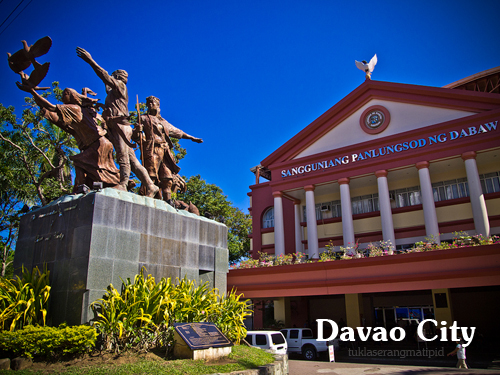
Davao City Municipal Hall
Nueva Vergara continued to progress as many people engaged to local businesses. The few numbers of Catholic converts however made Marquis de Solana, under Governor General Blanco’s order, to replace Uyanguren in the position. The natives continued to send petition to the local government to rename the place as “Davao”. Fortunately, their request was granted.
Davao continued to progress even in the arms of the next invaders, American and Japanese. Because of the increasing influence of the Japanese in the trade and economy of the region, town of Davao was converted into a city in march 16, 1936.
Festivals in the Davao Region
Here’s a full list of festivals in cities and municipalities around Davao City:

- Araw ng Dabaw (March 10-16)
- Kadayawan sa Dabaw (3rd week of August)
- Kaputian Parochial Fiesta (IGaCos – January 15) –
- Kasinatian Festival (Toril – October 7)
- IGaCoS Festival (IGaCos – March 5 -7)
- Caracoles Festival (IGaCos – April 30)
- Pangapog Festival (IGaCos – 1st Week of August)
- Babak Fiesta (IGaCos – September 15)
- Peñaplata Fiesta (IGaCos – December 8)
- Musikahan (Tagum – March 7)
- Kuradang sa Dalan (Panabo – March 31)
- Palay Festival (Carmen – June 18)
- Ugsod – ugsod Festival (June 18)
- Araw ng Davao del Norte (July 1)
- Banana Festival (Kapalong 1st Week of August)
- Banana Festival (Panabo – March 31)
- Durian Festival (Tagum City – August to September)
- Sinawug Festival (Asuncion, Davao del Norte – September 19)
- Kalibulongan Festival (Talaingod October 18)
- Andaon tu Dibabawon Festival (Kapalong – Last week of October)
- Feast of Christ the King (Tagum – 2nd to the Last Sunday of November)
- Saulogan Festival (Digos – January 15)
- Kapyaan Festival (Jose Abad Santos – February)
- Pista sa Kinaiyahan (Sta. Cruz – April 25-28)
- Dorong Festival (Kapatagan – June 14-19)
- Provincial Charter Anniversary (July 1)
- Padigosan Festival (Digos – September 8)
- Araw ng Sta. Cruz (Sta. Cruz – 1st Week of October)
- Mango Fiesta (San Isidro – June 18)
- LUBMAHUMA Festival (Provincial July 1)
- Fish Festival (Gov. Generoso – August 1)
- Niyog-Niyogan festival (Manay – October 25)
- Kagang-Kagang Festival (Caraga – October 25)
- Balyan Festival (Baganga – October 25)
- Sambuokan Festival (Mati – October 25)
- Anibina Festival (Compostela Valley – March 1-8)
- Maragusan Eco-Expo (Maragusan, ComVal – Last Week of April)
- Kaimunan Festival (Tagum – June 17)
- Sal-Lupuyon (Compostela Valley – June 12 – 18)
- Simballay Festival (Nabunturan – July 21)
- Kariyawan (Monkayo – Sept. 4)
- P’yagsawitan (Maragusan – 3rd Week of November)
"FAMOUS FOODS IN DAVAO"
Durian - King of Fruit

Durian has become almost synonymous with Davao City because of its abundance, and because of its scarcity in other parts of the Philippines, many have sought after this exotic fruit. Durian is widely known as the “King of Fruits”, and is abundant in Davao. Davao's rich fertile volcanic soil and climate make it most suitable for sustained production of the freshest and tastiest Durian. Since the fruits are locally produced, the prices are comparably much cheaper than anywhere in the country.
Davao City is typhoon-free. The city enjoys a balmy weather all year round. It is characterized by a uniform distribution of rainfall, temperature, humidity, and air pressure. It has no pronounced wet or dry season. Weather predictability makes it highly conducive to agricultural production. Temperature ranges from 20 to 32 degrees Celsius, and the average rainfall is up to 2,000 mm yearly.
"Authentic Davao Food"

Lip-smacking traditional Davao food
Davao City cannot be measured when it comes to eateries. It is so because the Dabawenyos' humble way of daily life dictates their simple tastes and choices of food. While roaming in and around the City, you may come to see so many lovely cafés and classy restaurants that are rich in dishing up lip-smacking traditional food along with international delights. Above and beyond, you can also relish your food with yummy wines, fruity numbers that come from the most elite and discriminating section of society loaded with big-gun ale.
Naturally, the capital city is a superlative place to dine where you are offered with choicest of cuisines available at roadside cafés and inns, chic bars, and plush eating joints. American hamburgers and french fried potatoes, Chinese cuisines, Korean food and Japanese tastes are able to satiate your hunger. The list of international specialities goes on and on and on . . . . It is okay to be fashionable and popular in dining, BUT NOT FOR ME!
Personally, I still prefer the simple and yet creatively prepared Davao everyday dishes made up of the lowly Matangbaka, Bangus, Malasugi, Tilapia, Pasayan, Alimango, Guso, Lato, Katambak, Moro-moro, Bodboron, Barileson, Lapu-lapu, Maya-maya, and the list goes on as well . . . . In my book, authentic Davao food is second to none!
" THINGS TO DO IN DAVAO"
"HIKING IN MOUNT APO"

“King of Philippine Peaks”, as it’s called, Mount Apo is one of South East Asia’s highest mountains and it’s right here in Davao. The mountain’s peak reaches an elevation of 10,311 feet which is 3,144 meters above sea level. Towards the top, there is a 500-meter wide crater lake created by volcanic activity. The mountain is home to rubber plantations, a 150-meter tall waterfall called Tudaya Falls, along with wild boar and deer.
During the moths of March, April, and October, experienced climbers can climb the summit during a two-day hike organized by various tour groups around the area.
"BALUT ISLAND"

There is a relatively underrated volcanic island at the southern tip of Davao Oriental that should be explored if you’ve got the chance.
Balut Island is home to a super interesting mixture of cultures including Muslims, Bilaans, and Sangils, who are native to Indonesia. Most of the locals here are farmers who export coconuts to surrounding areas. The mix of cultures means that you can find an international display of restaurants here.
While you’re on the island, you can take a dip in the Sabung Hot Spring overlooking the sea, stroll the undisturbed white sand beach, watch for Pygmy Sperm Whales in the water, and check out the ruins of fort Villa from WWI.
"KNOWN PERSON IN DAVAO"

BORN: 28 March 1945 (age 73 years)
FULL NAME: Rodrigo Roa Duterte
PRESIDENTIAL TERM: 30 June 2016 –
PARTY: PDP-LABAN
EDUCATIONAL BACKGROUND: san beda college of law (1968–1972)

- Erich Gonzales — One of today’s young faces in the showbiz industry was born and raised in Davao City until her early teenage years. Erich started her showbiz career at the age of 14, when she joined as a contestant of the reality talent search Star Circle Quest. Her popularity boomed after her lead role in the TV series Katorse. After having a successful love team with Enchong Dee and team up with Mario Maurer, she appears once again in the everyday primetime slot, as she becomes part of the biggest television series of ABS-CBN for 2013. Titled Juan Dela Cruz, she is paired up once again with Noy co-star and Prince of Teleserye Coco Martin as his leading lady. The show immediately became number one in national TV ratings during its pilot episode and is expected to continue throughout its run.
GROUP 5
LAPNO AERON JAMES
CERVANTES BENSON
PAGADORA GENEVIEVE
GANITNIT SHERLY JOY
GRADE 12- G SHALEM
MS. ,MAUREEN SAYLON

No comments:
Post a Comment